COVID-19 Advances Academic and Research Vision at WRH
7-12-2020
12.trials.are.underway.at.Windsor Regional Hospital as researchers put COVID-19 under the microscope to assist in the treatment of patients diagnosed with the virus.
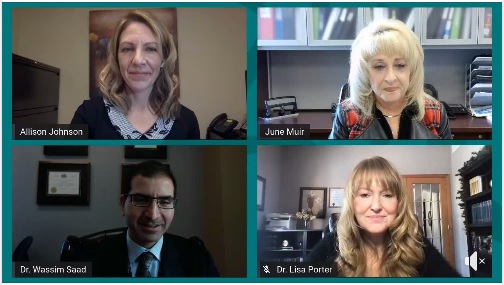
During the LIVE Coping with COVID webcast on Wednesday, December 2nd, Windsor Regional Hospital Chief of Staff Dr. Wassim Saad, Executive Director of WE SPARK Health Institute and Professor of Biomedical Science at the University of Windsor Dr. Lisa Porter and COVID long hauler June Muir discussed local research into the novel virus.
Among some of the local trials is an examination of the effectiveness of therapies to prevent the progression or cure people infected with COVID-19. There are two such trials ongoing at WRH; the CONCOR-1 Trial looking at Convalescent plasma with antibodies from recovered COVID patients to be given to infected patients and the ACT (Anti-Coronavirus Therapies) Trial examining various treatment options for patients with COVID to prevent its progression.
"Windsor Regional Hospital was one of the first hospitals to enroll and we had the very first patient in Canada enrolled in this (ACT) trial," said Dr. Saad.
Dr. Porter noted although COVID-19 is new, researchers knew it came from a family of viruses called the coronavirus, and data from the SARS outbreak gave researchers a starting point.
"People are saying we are so confused because the recommendations keep changing, but they keep changing because the clinics are keeping up with the research," says Dr. Porter. "As new data comes out, Public Health is keeping up and changing and we want to see that happening."
Research has moved at 'breakneck speeds', but for Muir who was diagnosed with COVID-19 back in March at the onset of the pandemic, the research did not happen fast enough.
"It was frustrating, it was discouraging and challenging. It caused a lot of anxiety," said Muir who turned to CNN's Chris Cuomo who was also COVID-19 positive and was broadcasting his show from his basement.
Both Porter and Saad are encouraged by on-going local research.
Dr. Porter says it is important to conduct local research because it involves the local population and attracts the latest cutting-edge drugs and equipment to the community which means local patients are getting access to that care.
Often times she says researchers work in silos, red tape acts as a barrier and a lack of dollars hinders any progress. The pandemic has removed those barriers and Dr. Saad agrees.
"If there is one good thing that could come from this pandemic is how quickly it pushed and advanced the academic and research vision of the hospital," he says.
One such research study is a planned registry to follow up with COVID-19 positive patients. At some point in the future, Dr. Saad says they are planning to contact positive patients in Windsor-Essex to follow-up with their recovery, whether they have fully recovered and how long it took to recover.
But local research is not limited to physical elements of the virus. As part of an Igniting Discovery Grant, a study has been conducted by Hotel-Dieu Grace Healthcare's Dr. Jennifer Voth, Linda MacDougall from the Faculty of Nursing at St. Clair College and Dr. Lindsey Jaber at the Faculty of Education at the University of Windsor.
Healthcare workers were invited to fill out a survey during Wave 1 and Wave 2 of the pandemic to look at the psychological impacts of the virus. 403 healthcare workers completed the survey in Wave 1 and about 150 in wave 2.
"What we are finding in both waves is a significant amount of psychological distress," says Dr. Voth. "For Wave 1, we found that 70% of our samples were experiencing high levels of psychological distress and for Wave 2, it is about 83 percent."
Psychological distress can include symptoms such as restlessness, fatigue, trouble sleeping, depressed mood, and anxiety which Voth says are normal responses to a pandemic. What is concerning is the long-term toll which can result in burnout, absenteeism, and extreme exhaustion, ultimately negatively impacting patient care.
In the last few weeks, there has been a lot of hype surrounding the vaccine by Moderna, Pfizer-BioNTech, AstraZeneca-Oxford, and Johnson and Johnson but Dr. Saad notes, a lot of questions remain unanswered.
"When the vaccine comes out, people will be vaccinated. One way to check if the vaccine is effective is to do antibody testing later on, but it is so new, we don't know how long that immunity is going to last," cautions Dr. Saad.
WATCH: Coping With COVID - Focus on Research
View more videos from the Coping with COVID series here.
The Coping with COVID webcast will resume in 2021 with new topics for discussion.